

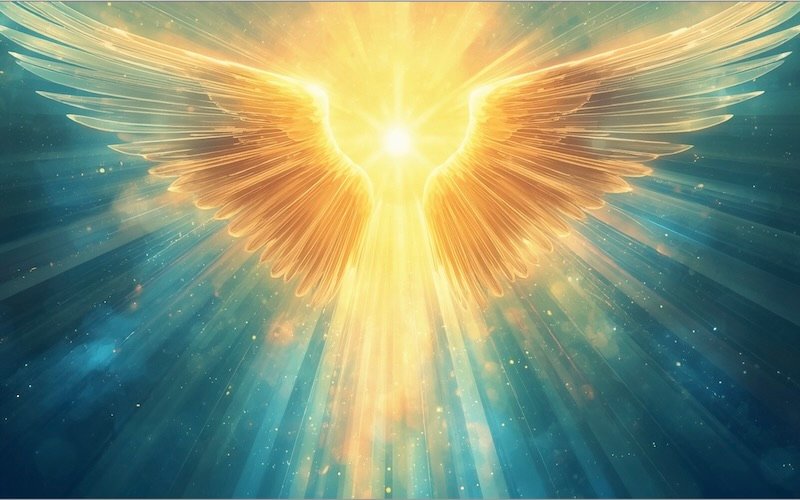
Belief in angels is the second of the six Islamic articles of faith (arkan al-iman). Islam holds that angels are created from light, are inherently worshipful, sinless and obedient to God, and can assume human form when God so wills. The angel Jibril, who brought the Qur’anic revelation from God to the Prophet Muhammad SAAS, is the best known, but Mikail, Malik, and Harut and Marut are also named in the Qur’an, and others are mentioned without being specifically named.
In the article below, pathbreaking British scientist Rupert Sheldrake uses the occasion of a Christian feast day to discuss the concept of angels. When he writes of people’s experience of angels being more than imagination as normally conceived—”it’s worth taking seriously the idea that the imagination may be bigger than individual minds”—the Muslim reader cannot help but be reminded of Ibn al-Arabi’s concept of the imaginal realm.
Most of Sheldrake’s observations apply to the Muslim tradition as well as the Christian one. An exception is the notion of “fallen angels,” which does not exist in Islam. The entities viewed as fallen angels in Christianity are jinn, not angels. Their (metaphorical?) essence is fire, which is of a lower vibrational frequency, and more potentially harmful, than the sheer light of which angels, the first emanation of God, are created.
-ABaB
Michaelmas: Saint Michael and All Angels
Rupert Sheldrake (watch the video of his talk)
Sept. 29
September 29th is the feast of Michaelmas, the feast of Saint Michael and All Angels, and it’s one of the important festivals in the Christian liturgical year. And it’s actually one of my favorite festivals, because it’s a time in which we can think about and indeed celebrate these mysterious beings that exist in all traditions, but about which most modern people have only the vaguest idea.
The angels appear in the Jewish scriptures. They play a number of important roles: announcing things, appearing to people in dreams, as messengers. They play a major role in the Christian story, including the Annunciation by the angel Gabriel to Mary about the conception of Jesus. Angels keep appearing in dreams to people and giving them messages. They play a big part in the Islamic scriptures, and beings very like angels, devas, the gods, the shining ones, appear in Indian scriptures and mythology. And all around the world we find stories of beings which are not human, but which can communicate with humans, which exist in a nonphysical realm.
Now, obviously, from the point of view of modern secular materialism, all this is just make-believe, impossible, because there is no conscious realm beyond human brains or animal brains. From the point of view of materialism, there’s just a dead, inanimate, purposeless universe governed by impersonal mathematical laws. None of it’s conscious, and there are certainly no nonphysical beings, because by definition, in a physicalist or materialist worldview, everything has to be physical.
So from this modern, secular point of view, angels are nothing but a residue of ancient folklore and superstition and mythology. However, despite the prevalence of secular education, surveys show that most people, certainly in the United States, about 70% of the population, believe in angels. In Britain, a much more godless and secular country, it’s about 30%. But that’s still many millions of people.
And many people claim to have experienced angels, beings that have helped them in moments of difficulty. Some people feel they’re guided by their guardian angels. Some people see angels. One of the most famous examples is Lorna Byrne, the Irish writer who claims that she sees angels everywhere. I once had lunch with her in Dublin, and she said she could see my guardian angel behind me, and it was very big and very luminous. So is she just deluding herself? Is this just a woman who hasn’t caught up with the modern world? Well, she is very convincing when she talks about them.
Once, my friend Matthew Fox was at an event in Grace Cathedral, San Francisco, with Lorna Byrne and said to her, “Can you see any angels here in the cathedral?” She said, “Yes, it’s full of angels.” And he said, “What are they doing?” And she said, “Well, they’re looking rather depressed.” And he said, “Why?” She said, “Well, because they’re unemployed.”
And Lorna Byrne said, “You know, the angels want to help us, but they can only help us if we ask them. And no one invokes them anymore. So most of them are unemployed.” Well, it’s sad to think of all these unemployed angels.
So anyway, what I want to do now is just say something about what angels might be. If we take the view that they exist in the realm of the imagination, which is a view which is acceptable to everyone (I mean, even the debunking materialists would say that they exist in people’s imaginations), then we can have a starting point. People see angels in dreams, and dreams are products of the imagination. People see angels in psychedelic experiences, and psychedelic experiences, visionary states, are in a sense a product of a supercharged imagination, or imagination on steroids, or on psychedelics.
So certainly people experience them. But are these experiences real in some sense? Well, there’s been an interesting debate in recent years about this, particularly in relation to psychedelics. Many people who take psychedelics, particularly dimethyltryptamine (DMT), say that in their visionary states they encounter what are often called entities, spirit beings, which seem utterly real and with whom they’re interacting. They encounter what Terence McKenna called “machine elves,” strange insect-like beings, animal spirits, but they also encounter angels. And so there’s a big debate among people who theorize about psychedelic experiences about the status of these entities.
If we start from the point of view that they are, in a way, creatures of the imagination, then this raises the question of what is the realm of the imagination. Is it just some individual thing created inside our heads by fevered activity of the brain, which would be the materialist view? Particularly when stimulated by psychedelics, it just goes into overdrive in terms of producing fantasies inside the brain. Or is the imaginal realm something which is bigger than our own brains, in which we participate in our dreams and in visionary experiences?
So I think it’s worth taking seriously the idea that the imagination may be bigger than individual minds. The psychologist Carl Jung thought in terms of the collective unconscious as a realm where the images from mythology, from fantasies, from the imagination, from collective experience exist: a mental realm greater than our own individual minds, into which our own individual minds can tap, or with which they connect. And if so, then angels could have a kind of transpersonal existence in that realm, and we could interact with them in it through dreams, through our imagination, and through psychedelic experiences and other altered states of consciousness, including near-death experiences.
Then a further question arises. Even so, might they be products of the collective imagination? When I got interested in this question, I thought about obvious mythological figures like the Indian god Ganesh. Ganesh is an elephant-headed god who’s a big part of Indian mythology, an important god as the remover of obstacles, believed to be a form of the god Shiva. But clearly, Ganesh couldn’t actually have existed, you know, a human with an elephant head. Some Hindus take it literally and say that it was an early example of the advances of Hindu technology many years ago, when they perfected head transplants. But obviously that’s a kind of crudely literal interpretation of something that’s much more imaginal.
So let’s say that Ganesh really is a product of the collective Hindu imagination. But then that doesn’t mean he’s purely imaginary or doesn’t have any kind of real existence. He may exist as an actual independent entity within that realm, where he appears to Hindus in dreams and in visions. When I got interested in this question, I looked online for dreams of Ganesh, and I found that within India there were lots of online discussion groups where people who had Ganesh dreams discussed them with each other. They were all convinced they’d seen Ganesh in their dreams, and they were discussing what he had said to them and how they’d interacted with him. Well, you could still say this is a kind of collective product, but the fact that Ganesh exists in many minds, goes beyond any individual mind, and can interact with those minds through dreams gives him more than a merely fanciful, imaginary quality.
And it seems to me that angels could be at least like that. And that doesn’t mean they’re nothing but the products of human imagination, because Ganesh, even if he’s a collective imaginal form that’s experienced in dreams or visions, could still be a channel through which a god, the god Shiva, or some other god, or the ultimate God, can speak to people or reach them.
Now, angels may have that kind of status, but according to the traditional understanding of angels, they go beyond that. They’re the intelligences that govern the natural world. They’re not just about humans and human imagination. In the traditional understanding, angels are conscious intelligences that work in and through nature. Some of you may have seen a book that I wrote with the American philosopher and theologian Matthew Fox called The Physics of Angels.
In this book we discuss the writings about angels by three key figures in the Western tradition. Firstly, Dionysius the Areopagite, who was probably a seventh-century Syrian monk who wrote in the Neoplatonic tradition and wrote about the hierarchies of angels. In his book The Divine Names he talks about angels, and he wrote a book on the celestial hierarchies, The Celestial Hierarchy, which is like a textbook of angels and framed a lot of subsequent Western thought on the subject.
We also have the writings of Hildegard of Bingen, the great medieval mystical abbess in Germany, who saw angels and interacted with them, and also the writings on angels of Saint Thomas Aquinas. Aquinas gave the most systematic exposition of medieval angelology. The view that they took was that there were nine levels of angels.
The top hierarchy, the first three, were the cherubim, seraphim, and thrones. The thrones are the angels of divine presence, conscious beings that are open to and filled with the presence of God. The seraphim are the beings that are filled with the fire and light of divine love. And the cherubim are the intelligences, the transhuman intelligences, that are filled with divine knowledge. They’re like cosmic archetypes, the media through which the divine will and mind permeate the universe.
Then there’s the next level of angels: dominions, virtues, and powers. These angels work at a more-than-human and more-than-worldly realm. Some writers associated them with the stars and the planets, and in the ancient world, the stars and the planets were all thought to be living, conscious beings. Some of these theorists thought that the angels were the minds or spirits associated with each of the heavenly bodies, the stars and the planets. Plato thought that the stars and the planets were gods. In fact, he called them visible gods. We can see the stars and planets, but they’re powers or intelligences that are higher than the human level, yet of course less than the divine. And we still call the planets by the names of gods and goddesses: Venus, Mars, Mercury, Uranus, and so on.
So their idea was that when they looked up into the sky, the stars and planets were conscious beings which could influence us and with which we could interact. They were intelligences, channels of divine love, knowledge and power.
When modern people look up at the sky, they just see heavenly bodies that are nothing but assemblies of matter: hydrogen bombs in the case of the sun, nuclear reactors in the case of the stars, and galaxies which are just aggregates of stars held together by gravitational forces. But within the current thinking of panpsychism, which is becoming increasingly widespread in the academic philosophical world, and which is, of course, a very ancient worldview, consciousness permeates all nature. There are forms of consciousness in all self-organizing systems, including stars, planets and galaxies. This is a point of view that I’ve developed myself in a paper I wrote recently in the Journal of Consciousness Studies called “Is the Sun Conscious?” I won’t go into it now, but you can make a good case that the sun, in a panpsychist universe, is a conscious being, and so are the other stars, with their own intelligence.
Now, what if we called the intelligence of the sun its angel, or its guiding angel? Then we’d have something very similar to the medieval view. We’re not just talking about a being that’s a product of human imagination, or even fevered imagination, but actually a kind of intelligence that’s out there in the sky, influencing life here on Earth, because we’re influenced continually by the activity of the sun.
So what interests me about angels in a panpsychist universe is the idea that there are many forms of consciousness or intelligence between human intelligence and the divine consciousness. The divine consciousness I take to be that consciousness on which all creation is based, through which all creation comes into being, through which the universe is sustained, present everywhere, at all times and in all places. And that ultimate intelligence is related to the whole universe and all the things within it through a series of creative intelligences and minds associated with galaxies and stars, and many levels of intelligence beyond the human. That actually is not very far from the traditional medieval view.
And when we come to the earth, there are three levels of angels on earth: principalities, archangels, and angels. The principalities are angels that govern large areas of the earth, like continents. The archangels govern whole peoples and whole collective realms. The archangel of the Jewish people is Michael, for example, also the archangel of Germany. So the idea is that there are these archangels that have wide remits, and then there are individual angels which guard different species of plants and animals. And then there are individual guardian angels for each person.
So the angels that most people talk about, angels that help them, or angels in angel calendars and New Agey pictures of angels, are the guardian angels. They’re the ones that are concerned with us and are the ones of most interest to us, I suppose, because they’re the ones closest to us. But in the traditional views, these are part of a much larger realm of conscious beings that go far beyond the human level.
Then, of course, there’s a whole realm of fallen angels. According to Aquinas, the only angels that could fall were the cherubim. Satan was a cherub, because divine knowledge can go wrong; knowledge can be fallen. But the angels of divine love and the angels of divine presence can’t fall. In the beginning, all angels were good. For example, Aquinas, when he’s discussing when the first angel fell (this is one of the passages we discuss in our book), says:
In all the angels, the first act of self-reflection was good, but then some went on to turn to the Word with praise, while others remained in themselves, swollen with pride. Thus, the first act was common to them all; it was by the second that they were separated. In the first instant they were all good, and in the second they divided into the good and evil.
So the traditional view is that not all the angels are good. The fallen angels, Satan and the host of fallen angels so vividly described in Milton’s great poem Paradise Lost, can wreak mischief in the world and in our lives. So not all spirits, not all transhuman intelligences, have a good effect. There are a lot of bad ones, too.
And this, again, is a very traditional view. In Marlowe’s play Doctor Faustus, Doctor Faustus has the good angel giving him good advice in one ear and the bad angel tempting him in the other ear. That’s a classic kind of pictorial representation.
Anyway, I don’t suppose anyone really knows that much about angels. Much of this, you could say, is speculation. And yet I think it’s very reasonable to believe there are intelligences beyond the human level. None of these, by the way, in the traditional understanding, are humanoid beings with wings, as in stained glass windows. The wings express their ability to move fast and be in different places. Some people may actually see them with wings in visionary states, but I think that is a product of the human imagination, or a way of interpreting these beings. People like Aquinas, Hildegard of Bingen and Dionysius the Areopagite were certainly not picturing angels as we see them in stained glass windows. So I think we have to move beyond that level if we’re going to think about them seriously.
And I’d end by saying that personally, I find the festival of Saint Michael and All the Angels particularly important because we don’t understand much about them. I think that there are such beings and they do influence our lives, even though we may not understand them. And this is a festival when we can celebrate them, acknowledge them, sing hymns about angels. I personally will be celebrating Michaelmas at the village church in Somerset, Saint Michael and All Angels, Dinder, near Wells, where they’ll have a special festival evensong sung by the chamber choir of Wells Cathedral.
But there’ll be services on Sunday, September the 29th, the feast of Saint Michael and All the Angels, Michaelmas, in all the cathedrals in the British Isles, and indeed in cathedrals throughout the world, and in many parish churches. If anyone’s interested in going, there’s a website called choralevensong.org where you can look up these services anywhere in Britain or Ireland. You just put in the place and it’ll tell you the nearest ones, and with one more click you get the music list.
And if you can’t go, or if you’re not in Britain or Ireland or anywhere where there’s a cathedral nearby, you can actually attend some of these English cathedral services (Canterbury, Winchester, Durham, Salisbury and so on). They do live streaming. So from the comfort of your home, you can actually attend a Michaelmas service on September 29th, in the evening or in the morning. They have them in the morning too, but the evening ones are the ones that are easiest to access, and choralevensong.org is a portal through which you could do it.
So that’s all I wanted to say about angels. And I think now we’ll open this up. I’m sure everyone has an opinion, or many opinions, on the subject, so it’ll be very interesting to see what happens.